Consistency and Standards
Different parts of your product have started following different rules.
The same action behaves one way here, another way there. New features arrive with their own patterns. What was once a single system now feels like several, stitched together without a shared logic.
Small decisions that should stay local start surfacing as escalations — not because they're hard, but because no one knows which rule applies.
When shared rules don't exist, you become the rule. Every inconsistency eventually routes back to someone who remembers how it was supposed to work.
Definition
Teams make reasonable decisions in the moment, based on the context in front of them. Each choice fits the local problem it was meant to solve.
Similar situations start being handled in different ways. Behavior depends on where a feature lives, who built it, or which decision came first. Past choices do not carry forward as shared reference.
Patterns stop behaving like rules. Each new case requires a fresh decision, even when the situation looks familiar. The work itself does not become more complex, but it becomes harder to transfer, because the system no longer carries a single way of behaving that the team can rely on.
Business Impact
Team scalability
Limits team scalability because the system does not carry shared patterns, forcing decisions to depend on local interpretation or escalation.
Client trust
Erodes trust because the system allows the same action to behave differently across contexts, breaking expectations it does not maintain.
Product velocity
Slows product velocity because the system does not enforce reuse of existing patterns, requiring each new case to be resolved independently.
Example
Acting on any item
Bitwarden
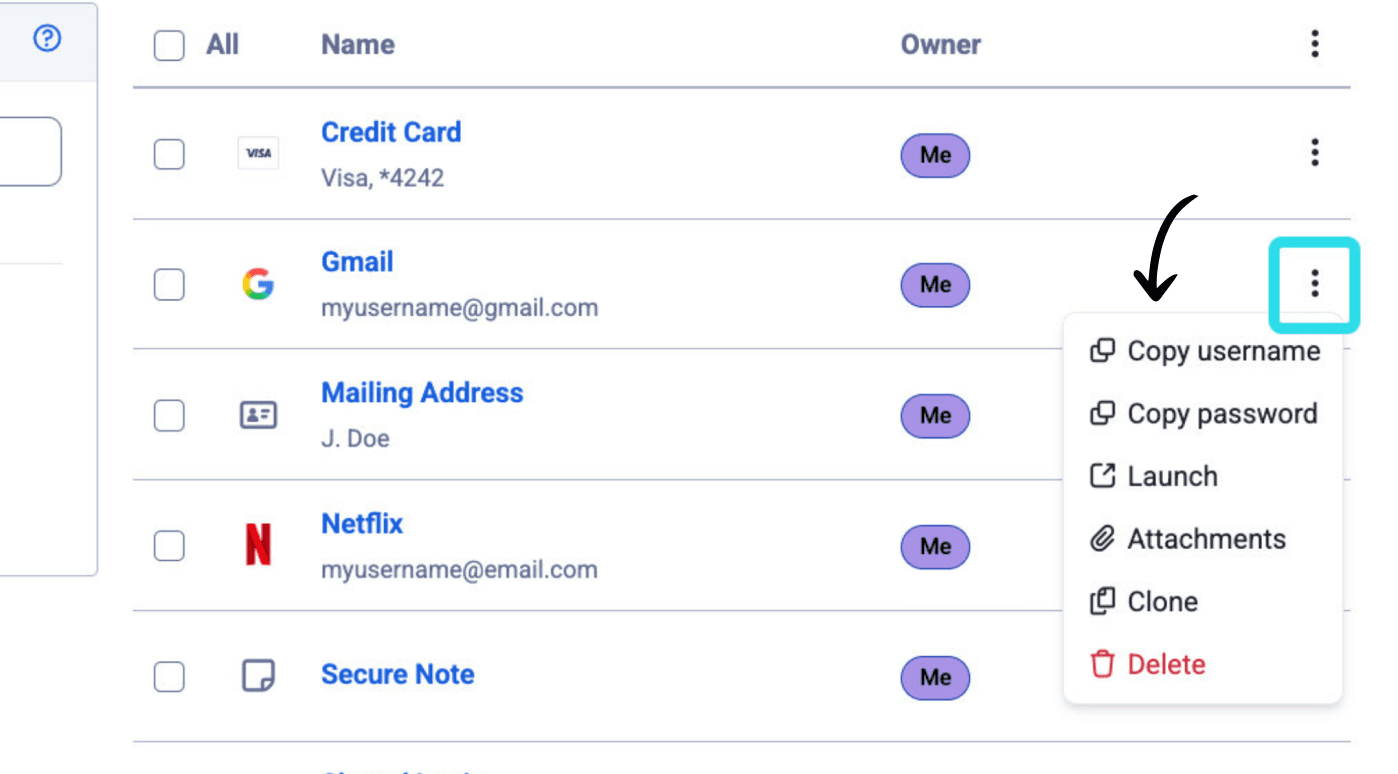
System decision: Item actions work the same way regardless of which vault the item belongs to, instead of adapting the available actions to vault type or ownership.
What was chosen: The same action menu — Copy username, Copy password, Launch, Attachments, Clone, Delete — appears for every item across personal and organization vaults.
What was avoided: Action sets that change based on vault type or item ownership, requiring users to learn which actions are available in which context.
Complexity removed: Acting on an item does not depend on knowing which vault it belongs to — the same set of actions is available everywhere.
Reviewing controls
Vanta
System decision: Every control follows the same row structure regardless of its domain or type.
What was chosen: The same columns — ID, Control, Owner, Frameworks, Tests — appear on every row with the same actions available throughout.
What was avoided: Domain-specific layouts that change when moving between Asset, Business Continuity, or other control categories.
Complexity removed: Controls are treated as the same type of entity regardless of their domain or framework.
Bringing System Clarity
Audit
Local variations start accumulating quietly. A pattern is introduced in one place, a slightly different version appears somewhere else. No one decided they should be different — they were just built at different times, by different people, without a shared reference.
This shows up when:
the same action behaves differently depending on where it happens
new features introduce patterns that contradict existing ones
teams ask “how did we do this elsewhere?” before making decisions
users ask why the same action works one way here but not there
onboarding or support materials exist mainly to explain inconsistencies
discussions about “the right way” recur without resolution
A useful boundary: When the team can’t name the rule behind a behavior, consistency has already moved out of the system.
System Rules
Without shared rules, each team makes local choices. Those choices accumulate into competing patterns because no single way of behaving holds across contexts.
Where the system stops maintaining shared behavior:
which patterns are canonical and reused by default
what behavior is enforced for common actions (save, delete, cancel, confirm)
how similar situations resolve across different contexts without variation
where variation is allowed — and where it does not hold across contexts
A useful boundary: When the same situation produces different outcomes without that difference being made explicit, consistency is no longer part of the system.
Decision ownership
The team applies existing patterns without interpretation. That is a local decision.
Once behavior is no longer determined by a shared pattern, decisions stop being local. The team must interpret how something should behave, and similar cases begin to diverge.
Questions that help maintain clarity:
Does a pattern for this already exist in the system?
Are we reusing that pattern, or introducing variation?
If this differs, is that difference visible in the system, or does it require explanation?
Escalation becomes necessary when a decision introduces a new pattern, changes an existing one, or creates variation that does not stay consistent across similar cases.
A useful boundary: When similar situations cannot resolve the same way without explanation, the decision moves beyond the team.
Common Decision Patterns
Questions about consistency often sound like this:
“Should we do this differently here?”
“Can this team use their own approach?”
“Should we try something new for this case?”
These are not feature questions. They are system behavior questions.
Under pressure, variation accumulates:
a button follows a different pattern because the standard is not enforced
a flow skips a step because similar cases are allowed to diverge
a term changes because no single definition exists
The question to ask:
“Are we following an existing pattern, or starting a new one?”
If the answer depends on interpretation, the pattern is not shared.
Conclusion
When consistency breaks, it rarely looks like a failure. The system still works. Teams keep shipping. Most decisions still get made.
What changes is harder to spot. The same situation no longer leads to the same outcome, and people start relying on how things were done before instead of what the system makes clear now.
This is a signal worth noticing. Not to enforce uniformity, but to see where shared behavior quietly stopped being shared — and where decisions no longer move on their own.
Recognize this in your product?
Let's talk about what's behind it.