Recognition Rather than Recall
Your team keeps asking the same questions, even though the answers haven’t changed.
Not because they forgot — but because the system doesn’t surface what matters when decisions are made. Important options are hidden, past choices disappear, and context resets between steps.
As complexity grows, the product starts relying on people to remember instead of helping them recognize.
That’s when decision quality becomes fragile — and clarity quietly moves out of the system.
Definition
Key information is missing at the moment decisions are made. Earlier choices, relevant details, or available options are not present in the current state of the interface.
To move forward correctly, people rely on what they remember instead of what they can see. The system does not surface prior context when it is needed, even though that context already exists.
Decision quality depends on recall rather than recognition. Responsibility shifts from the interface to the person trying to reconstruct what the system does not show.
Business Impact
Risk
Increases risk because the system allows decisions to be made without carrying the context they depend on.
Team scalability
Limits team scalability because the system does not retain or surface prior choices, forcing knowledge to live in people instead of in the system.
Operational cost
Slows product velocity because the system requires teams to reconstruct missing context before acting.
Example
Password change history
1Password
System decision: The history of a credential record is visible within the record itself, instead of being stored separately and requiring navigation to access.
What was chosen: "Last edited Monday, March 10, 2025 at 9:03:23 AM," "Added Monday, March 10, 2025 at 7:20:50 AM," and "View previous versions" — all visible without leaving the record.
What was avoided: Storing change history separately, with navigation required to find out when the record was last modified or what it previously contained.
Complexity removed: Whether a password is current can be judged from what is visible in the record, without recalling when it was last changed or searching for that information elsewhere.

Risk scoring preview
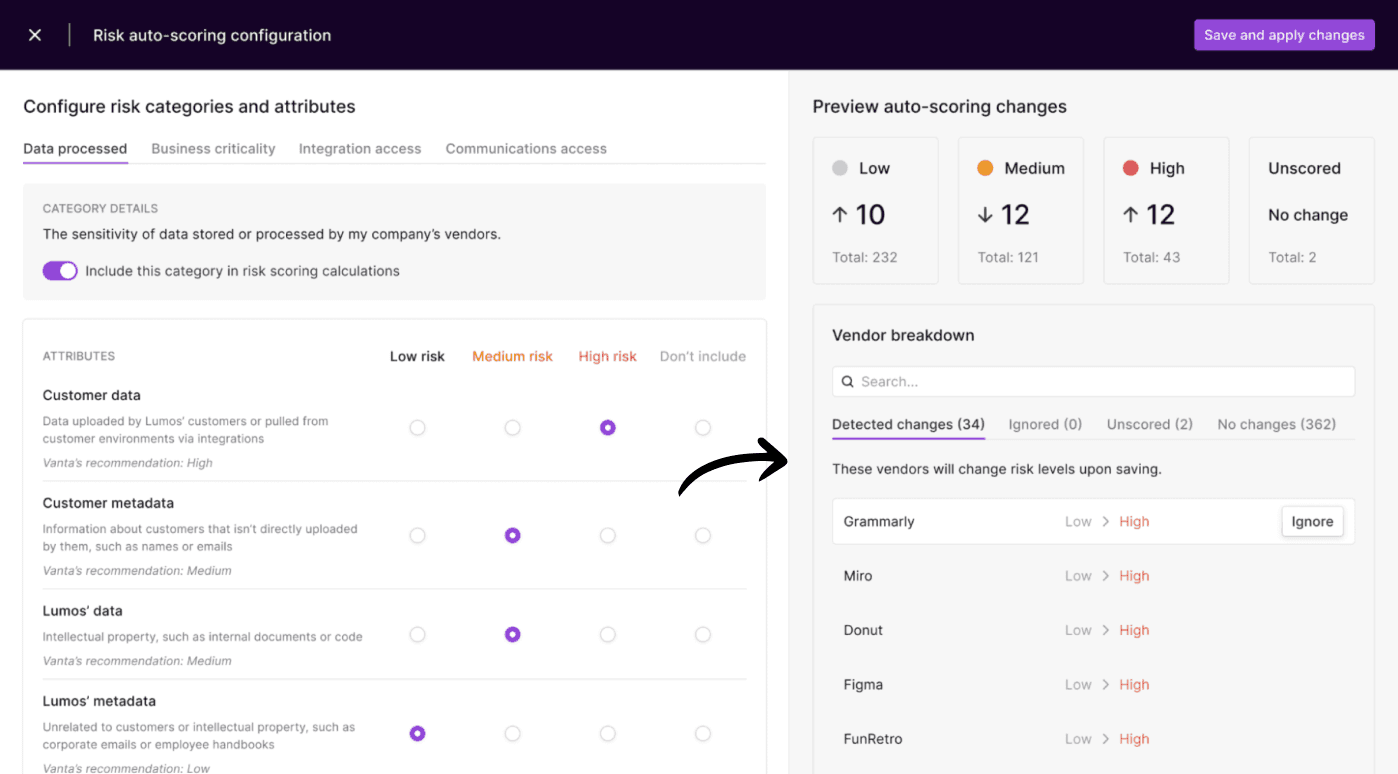
Vanta
System decision: The impact of configuration changes is visible alongside the settings being adjusted.
What was chosen: A live preview panel — "Preview auto-scoring changes" — showing which vendors will change risk levels and in which direction.
What was avoided: Requiring the user to save changes first and review the results separately.
Complexity removed: Users assess the impact of their settings from what is visible, without saving, navigating away, or recalling how previous configurations affected vendor scores.
Bringing System Clarity
Audit
At a certain scale, recognition often breaks quietly. The system still “supports” the work, but it stops carrying enough context for someone to make the next decision with confidence. People start relying on what they remember from last time — or on whoever remembers.
This shows up when:
the same task takes longer for anyone who doesn’t use it daily
teams keep a mental map of “where things are” instead of the system making them obvious
users re-check previous steps because earlier choices are no longer visible when they matter
multi-step flows depend on remembering earlier inputs, settings, or constraints
support and internal questions start with “Where do I find…?”, “Which one did I pick?”, “What’s the difference again?”
decisions escalate because the system doesn’t make the current state and allowed actions clear enough to trust
A useful boundary: If a correct decision depends on remembering what happened earlier, recognition is no longer owned by the system.
System Rules
Decisions depend on context that already exists in the system, but that context is not always carried into the moment where it is needed.
The system does not lose information — it loses its availability.
What typically breaks:
previous choices are no longer visible when they matter
relevant options are hidden or removed too early
current state does not reflect prior decisions
multi-step flows drop context between steps
users must reconstruct what they already selected or saw
A useful boundary: Decisions made without visible context rely on memory rather than on the system.
Decision ownership
The system already holds the context this decision depends on. Whether that context is surfaced at the moment of choice determines where the decision actually happens.
When context is visible, the decision remains within the system. When it is not, the decision shifts into memory — carried by the person instead of the interface.
Questions that help maintain clarity:
Can this decision be made from what is visible right now?
Does correctness depend on a previous choice that is no longer shown?
Would someone unfamiliar with the history decide the same way?
Is any part of the logic carried only through memory?
A useful boundary: When the current state is not enough to decide, the decision no longer stays within the system.
Common Decision Patterns
Decisions that remove context often appear as small cleanups:
“Should we hide this once it’s done?”
“Should we clear this after the user leaves?”
“Do we need to keep showing this?”
“Can we simplify this by removing earlier steps?”
The result is not simplification — it is missing context at the next decision.
Patterns tend to cluster:
earlier choices are removed before they matter again
context is dropped between steps
differences are handled through explanation
familiarity fills gaps the system no longer carries
correctness depends on having seen this before
The question to ask:
“Could someone decide this correctly without remembering what happened earlier?”
If the answer depends on recall, the issue isn’t the decision itself.It’s that the system is no longer carrying what the decision depends on.
Conclusion
When decisions rely on recall, they slip out of the system and into people’s heads. What looks like simplification often means correctness is no longer visible when it matters.
Recognition changes this. When the system carries the context decisions depend on, there’s no need to reconstruct the past. Decisions become repeatable because the right choice is legible.
This isn’t about fixing flows or adding guidance. It’s about noticing where memory has entered decision-making — and reducing decisions that depend on remembering.
Recognize this in your product?
Let's talk about what's behind it.